The Complete Buying Guide to Omega Watches
First watch on the Moon. A classic James Bond model. Worn on the wrist of JFK and Mikhail Gorbachev at their respective inaugurations, and on the wrist of Mao Zedong for 31 years. Elvis Presley wore one while cruising in his purple Cadillac, and today George Clooney wears one while cruising on a Vespa. A paradigm-shifting mechanical movement designed by the 20th Century’s greatest watchmaker. The only brand to truly compete with, and sometimes dominate, Rolex. A Babe Ruth-style run as some the most accurate watches in the world, and the official timekeeper for the Olympic Games over and over. This is Omega, one of the greatest Swiss watch companies of all time.
Omega has been around under one name or another since 1848, but today’s lineup draws heavily on its classic mid-20th-century designs. Though not quite as slow to evolve as Rolex, Omega has incrementally developed its watches such that they feel simultaneously historical (though not anachronistic) and modern (though not trendy).
George Daniels was an orphan in London who, during the 1960s and 70s, worked to fix a friction problem with the standard “lever escapement,” which had regulated mechanical watches for close to three centuries. He fixed the friction problem, thus offering the first significant horological contribution in hundreds of years, and he named it the co-axial escapement.
Omega bought the patent in 1999, and has recently built new, high-tech facilities to nurture the co-axial escapement — as well as their Master Chronometer program — into the 21st Century. The co-axial mechanism, Omega argues, reduces service intervals (which lowers the price of ownership), and it helps maintain accuracy. When you buy an Omega with a co-axial movement today, you’re getting an advanced mechanism and an important piece of horological history.
Though the co-axial escapement constitutes a serious innovation, one “trend” Omega has followed, however, is today’s obsessive production of limited editions. While we can’t chase down all the LEs for you here (they’re often gone within minutes of release anyways), we encourage you to follow your curiosity about them, should you have any.
As for the core Omega lineup, we have assembled a quick reference guide that’ll help you get familiar with the Omega landscape and point you to specific watches that epitomize the brand’s best offerings. We have elected not to show every single available model in the interest of clarity and brevity, but this guide should serve as a good starting point.
The Speedmasters:
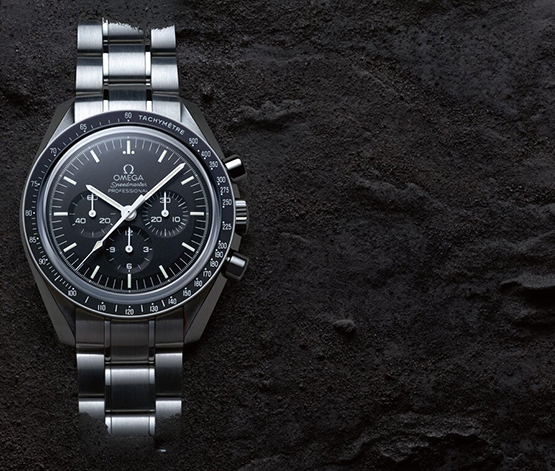
Originally designed for motorsports and often cited as the Porsche 911 of watches, the Speedmaster became The Moonwatch when Buzz Aldrin stepped onto the lunar surface in 1969 wearing his trusted reference ST105.012. Today’s Speedmasters come in many styles and sizes, from historically accurate recreations to solid gold diamond-encrusted shiners, to ultra-light carbon technical wonders. Here are four Speedmasters worth knowing about.
The Speedmaster Moonwatch Professional Chronograph 42mm:
An essential model, this is a modern take on the original Speedy that adorned Buzz Aldrin’s wrist 50 years ago when he set foot on the moon. Still featuring a hand-wound Omega caliber, it doesn’t get much more iconic or handsome than this.
Speedmaster Professional Chronograph 39.7mm:
Smaller and sporting a solid case back, this model is more vintage-y than its larger cousin. This watch is noted as The First Omega in Space, as it’s based on the model that accompanied Wally Shirra when he orbited Earth in 1962.
Speedmaster Moonwatch Omega Co-Axial Chronograph 44.25mm “Dark Side of the Moon”:
The modern looks, larger size, carbon case, and high performance co-axial movement make this Speedmaster unabashedly of-the-moment. (See also the Gray and White Side of the Moon.)
Speedmaster Skywalker X-33 45mm:
A modern upgrade of the X-33 released in the 1998, the Skywalker X-33 was designed with astronauts in mind. To that end, it features a quartz-powered ana-digi display with multiple time zones, three alarms, a chronograph, countdown functions and more. It may not look like a traditional Speedmaster, but it’s a natural evolution of the Space Age original.
The Seamasters:
This is a confusing line within the brand because Omega produced what were essentially splash-proof dress watches under this monicker for decades. At the same time, the Seamaster line has included Omega’s most robust, high-tech dive watches. That confusion isn’t entirely gone today from the lineup, but the waterproofness has been upped significantly across the line. Here are today’s essential Seamasters that you’ll want to know about.
Diver 300M Co-Axial 42mm:
Made truly famous when Pierce Brosnan’s costume designer decided James Bond should wear what the British Royal Navy was sporting during the 1990s, we saw 007 drop his Rolex Sub in favor of a quartz Seamaster 300. (Daniel Craig strapped on a mechanical 300M more recently.) The 300M has maintained its looks and specifications over a slow evolution for a few decades, making it one of Omega’s most consistent models. The threaded helium escape valve at 10-o’clock gives the watch a quirky asymmetry, while the wave dial begs to be viewed under a loupe. There are many variants to choose from, though we like the liquidy blue and silver quite a bit. Also available as a chronograph, in precious metals, and so on.